
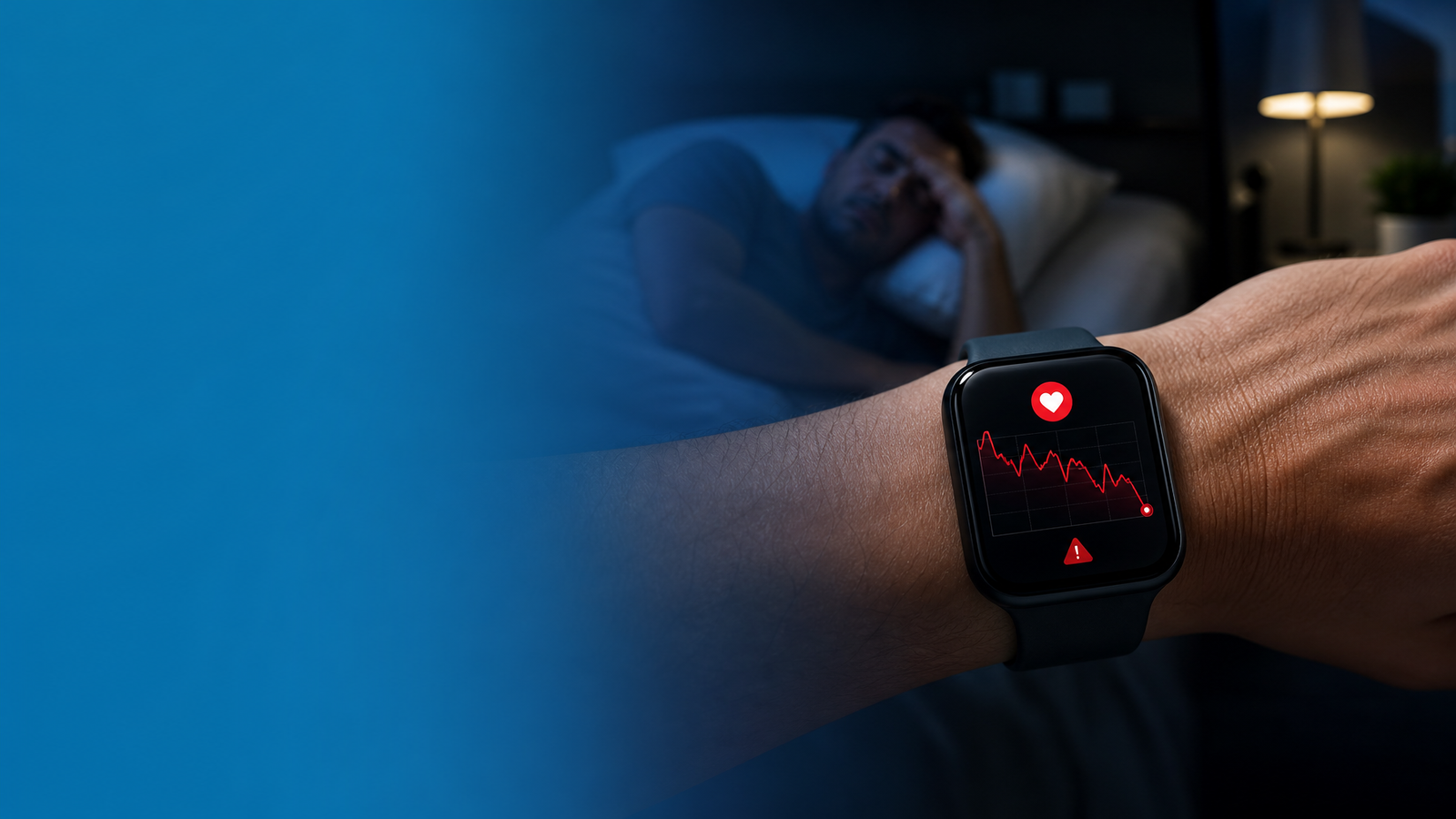
#TLDR: HRV and sleep apnea are deeply connected. Obstructive sleep apnea causes measurable autonomic nervous system dysfunction that suppresses HRV overnight and often for hours after waking. If your WHOOP, Oura Ring, or Garmin consistently shows low HRV and you cannot explain it with training load or stress, untreated sleep apnea may be the cause. New 2025 research confirms that sleep HRV can predict stroke, depression, and cognitive dysfunction before symptoms appear.
What HRV Actually Measures
HRV and sleep apnea share a root cause: dysfunction of the autonomic nervous system. To understand the connection, start with what HRV actually measures.
Heart rate variability is the variation in time between consecutive heartbeats. A healthy heart does not beat like a metronome. The interval between beats fluctuates constantly, rising and falling in response to breathing, stress, activity, and recovery. Higher variability generally indicates a more responsive, adaptable autonomic nervous system. Lower variability indicates stress, fatigue, or dysregulation.
HRV is controlled by the two branches of the autonomic nervous system: the sympathetic (fight-or-flight) and parasympathetic (rest-and-recover). In a healthy, rested person, parasympathetic tone dominates during sleep, driving higher HRV and allowing the body to recover.
The Direct HRV and Sleep Apnea Relationship
Heart rate variability and sleep apnea are so closely linked that HRV analysis is now being studied as a non-invasive screening method for OSA.
A 2026 open-access study published in Respiratory Research confirmed that non-linear measures of HRV can detect sleep apnea with meaningful clinical accuracy using ECG data. The study found specific HRV disruption patterns in OSA patients that distinguish them from healthy sleepers. Source: Springer Nature
A 2025 study in Frontiers in Neurology, conducted at King Abdulaziz University, demonstrated that machine learning algorithms applied to HRV data from ECG recordings could evaluate sleep apnea severity in detail, suggesting that future wearable-based HRV monitoring could serve as a useful OSA pre-screening tool. Source: Frontiers in Neurology
Why Sleep Apnea Destroys Your HRV
The mechanism connecting low HRV and sleep apnea is direct and well-established.
Each obstructive apnea event follows this sequence:
- Airway collapses. Breathing stops.
- Blood oxygen drops. CO2 rises.
- The brain triggers a sympathetic stress response.
- Adrenaline spikes. Heart rate surges.
- Breathing resumes. The cycle immediately repeats.
This repeated sympathetic activation during sleep prevents the parasympathetic nervous system from ever fully dominating during the night. Instead of recovering overnight, the body spends each night in a state of intermittent stress arousal.
The result at the HRV level is suppressed parasympathetic tone, elevated sympathetic markers, and a flattened HRV trend that tracks consistently below your expected baseline. Even after you wake up, sympathetic nervous system activation from the night persists for hours.
This is why people with untreated sleep apnea often show low HRV, high resting heart rate, and low recovery scores in their wearables despite spending eight hours in bed.
What the 2025 and 2026 Research Confirms
The clinical implications of sleep HRV go beyond OSA detection.
Research presented at the European Academy of Neurology (EAN) Congress 2025 analyzed 4,170 individuals over 13,217 person-years. The study found that HRV during sleep serves as a powerful early warning sign of future health conditions, including stroke, depression, and cognitive dysfunction, even in people with no obvious sleep problems at time of measurement. Source: News Medical
A 2025 study in Scientific Reports analyzing the Sleep Heart Health Study database (5,335 participants) confirmed that OSA produces specific, measurable autonomic nervous system alterations through HRV that are distinct from insomnia and other sleep disorders. Source: Nature Scientific Reports
For anyone using a wearable to track HRV, these findings mean: a persistent, unexplained HRV trend below your personal baseline is a signal worth taking seriously, not normalizing.
Reading Your HRV Data: What Patterns Signal OSA
Your HRV sleep apnea risk is higher when your wearable data consistently shows:
- Chronically low HRV that does not improve after rest days or reduced stress
- High resting heart rate overnight that fails to drop to normal recovery levels
- SpO2 readings regularly dipping below 94% during sleep
- Elevated respiratory rate overnight (above 18 breaths per minute)
- Poor recovery scores despite adequate sleep duration
- HRV that is lower in the morning than at bedtime, suggesting the night was physiologically taxing rather than restorative
Healthy sleep should raise your HRV overnight. If your data shows the opposite pattern night after night, your airway is worth investigating.
HRV Recovery After Sleep Apnea Treatment
Patients who receive effective sleep apnea treatment consistently report improvement in their wearable HRV metrics within weeks.
When apnea events are eliminated and parasympathetic nervous system tone is restored overnight, HRV rises to reflect genuine recovery. Heart rate drops to healthy resting levels. Recovery scores improve. Patients often describe feeling like their body is finally doing what sleep is supposed to do.
This is one of the most motivating outcomes for wearable-using patients: they can see their treatment working in the data they already track every day.
From Low HRV to Confirmed Diagnosis in Dubai
If your HRV data points toward sleep apnea, the right response is a clinical sleep assessment, not more biohacking.
At Leila Hariri Dental and Sleep Apnea Clinic, we assess patients whose wearable data tells a story their daytime symptoms do not yet fully reveal. We provide sleep studies to confirm OSA diagnosis, and custom oral appliance therapy as a CPAP-free treatment option for Dubai residents. Learn more on our Sleep Apnea Treatment page.
Book a Sleep Apnea Assessment at LHDM
Your HRV score is one of the most honest data points your body generates. If it is consistently low without a clear training or stress explanation, your airway deserves investigation.