
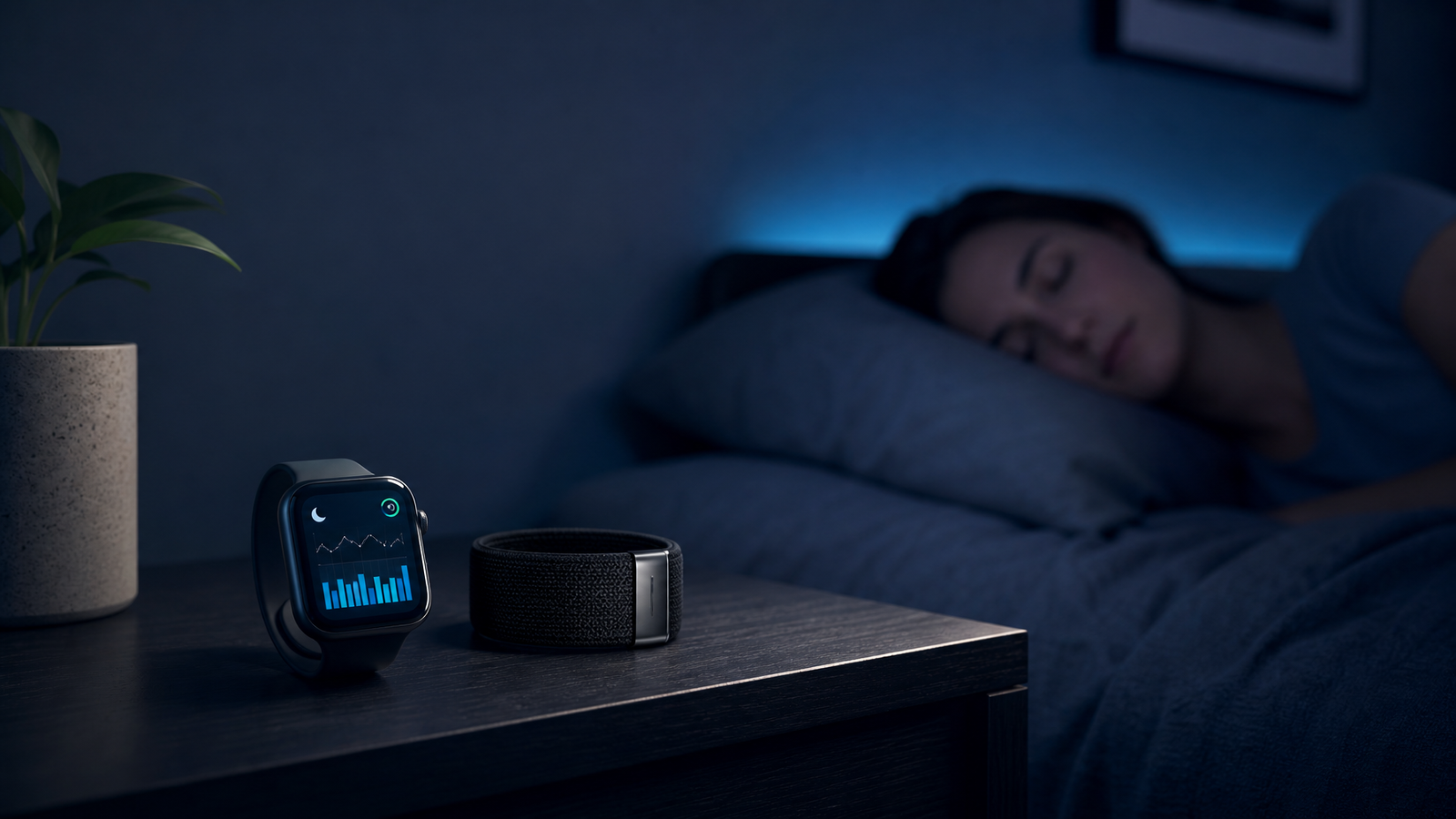
#TLDR: Wearable sleep apnea detection devices like Apple Watch and WHOOP have improved dramatically, but they cannot diagnose obstructive sleep apnea. Apple Watch Series 9 and later has an FDA-cleared feature that detects signs of moderate-to-severe sleep apnea. WHOOP and Garmin track sleep quality but do not screen for OSA. All wearables fall short of the polysomnography gold standard. If your device is flagging concerns, treat it as a prompt to see a specialist, not a diagnosis.
What Wearable Sleep Apnea Detection Actually Means
Wearable sleep apnea detection is one of the most searched topics in consumer health technology right now, and for good reason. Millions of people wear devices that track their sleep every night, and many are wondering whether those devices can tell them something meaningful about their breathing.
The short answer is: some can flag a risk. None can confirm a diagnosis.
Obstructive sleep apnea (OSA) is characterized by repeated airway collapses during sleep, each one causing a measurable oxygen drop, a stress arousal, and a disruption to sleep architecture. Diagnosing OSA properly requires a sleep study that monitors blood oxygen, airflow, brain activity, muscle movement, and heart rate simultaneously. No wrist-worn wearable currently does all of that.
What modern devices do well is detect patterns that correlate with poor sleep, low overnight SpO2, and high resting heart rate. These are meaningful signals. They are not diagnoses.
Apple Watch Sleep Apnea Feature: What It Can and Cannot Do
The most significant development in Apple Watch sleep apnea screening came with the September 2024 release of the Sleep Apnea Notification feature on Apple Watch Series 9, Series 10, and Ultra 2.
Apple’s own technical documentation describes the feature precisely: the watch measures Breathing Disturbances during sleep, and if those disturbances reach a level associated with moderate-to-severe sleep apnea over a 30-day observation window, it sends a notification. Source: Apple
This feature received FDA clearance as a software-based screening tool. It does not diagnose OSA. It alerts users to seek medical evaluation. Apple is transparent about this distinction.
Key limitations to understand:
- The feature only works on Series 9, Series 10, and Ultra 2, not Apple Watch SE.
- It requires at least 10 nights of tracked sleep data per 30-day window.
- It is designed to detect moderate-to-severe OSA and may miss mild cases.
- A notification is a screening alert, not a medical result.
WHOOP and Garmin: Sleep Tracking Without OSA Screening
WHOOP sleep apnea screening does not exist as a feature. WHOOP is one of the most detailed physiological monitoring platforms available to consumers, tracking HRV, respiratory rate, SpO2, and sleep stages. But it does not include an algorithm designed to detect signs of OSA.
What WHOOP does provide is useful context:
- Elevated respiratory rate during sleep
- Lower-than-baseline SpO2 readings overnight
- Consistently poor sleep stage distribution with insufficient deep sleep
- Low recovery scores despite adequate sleep time
These patterns are not diagnostic, but they are clinically relevant. A WHOOP user consistently showing elevated respiratory rate, poor HRV, and fragmented deep sleep stages should discuss those trends with a doctor.
Garmin devices follow a similar model. A 2026 study examining 15 wearables against polysomnography in a sleep lab found that most wrist-based wearables perform reasonably at detecting total sleep time and wakefulness but perform poorly at staging deep sleep and REM with clinical precision. Source: We Love Cycling / University of Salzburg Study
What the 2025 Science Says About Wearable Accuracy
A 2025 peer-reviewed validation study published in PMC assessed six commercial wrist-worn wearables against polysomnography for sleep stage scoring. The findings confirmed that while wearables have improved significantly, none achieved clinical-grade accuracy in detecting sleep-disordered breathing events. Source: PMC/NIH
A comprehensive 2026 analysis of 17 peer-reviewed studies by Kygo Health found that wearable accuracy varies significantly by metric. SpO2 tracking is reasonably reliable at a population level. Sleep staging accuracy remains limited compared to EEG-based polysomnography. Source: Kygo Health
The conclusion from the research is consistent: wearables are valuable screening tools and trend monitors. They are not medical diagnostic devices.
Why Wearables Alone Are Not Enough
The danger in relying solely on OSA wearable devices is twofold.
First, a negative result from a wearable may provide false reassurance. Someone with mild-to-moderate OSA may never receive an Apple Watch alert but still experience hundreds of airway collapses per night that erode their health over years.
Second, a positive alert without follow-up is medically incomplete. Knowing that a device flagged breathing disturbances tells you nothing about the severity of the condition, the anatomical cause, or the appropriate treatment.
OSA requires professional assessment, a sleep study (in-lab or home-based), and expert evaluation of results before any treatment decision is made.
5 Signs Your Wearable Data Is Telling You Something Serious
Regardless of brand, take action if your wearable consistently shows:
- Overnight SpO2 dropping below 94%
- Respiratory rate above 18 breaths per minute during sleep
- Minimal or absent deep sleep stages over multiple nights
- HRV significantly below your personal baseline every morning
- An explicit Apple Watch sleep apnea notification
Any combination of these warrants a formal sleep assessment.
From Wearable Alert to Proper Diagnosis in Dubai
If your wearable sleep apnea detection device has flagged a concern, the next step is a clinical assessment, not a Google search. A sleep study, either an in-lab polysomnography or a validated home sleep test, will measure actual apnea-hypopnea index (AHI), oxygen desaturation patterns, and sleep architecture with the precision needed for a real diagnosis and treatment plan.
At Leila Hariri Dental and Sleep Apnea Clinic in Dubai, we work with patients who come in with Apple Watch alerts, WHOOP trends, and Oura Ring data showing disrupted sleep. We take that data seriously as a starting point and then provide the clinical evaluation needed to confirm or rule out OSA, and to design treatment accordingly.
Visit our Sleep Apnea Treatment page to learn more about how we help Dubai residents get from wearable concern to confirmed care.
Get Assessed at LHDM Dubai
Your Apple Watch or WHOOP is a powerful health monitor. It is not a sleep clinic.
If your device is raising concerns about your breathing during sleep, that signal deserves a proper clinical response. Our dental sleep specialists at LHDM offer non-surgical, CPAP-alternative treatment for obstructive sleep apnea in Dubai.